Tall conifers can often be reduced safely, but only back to living green growth, because most will never regrow from bare brown wood.
Fast-growing conifers such as Leylandii are often planted as a quick screen, then left to grow for years. Many reach a height and width that casts heavy shade, drains the soil and towers over fences and neighbouring gardens. South Wales's mild, damp climate suits them well, so they can shoot up faster than owners expect. The longer they are left, the harder and more expensive in effort the reduction becomes. Acting while there is still plenty of green growth gives you far more choice.
The most important thing to understand is that most conifers do not regrow from old, bare wood. If you cut back into the brown, leafless centre, the branch simply stays bare and the gap is permanent. A reduction therefore has to stop within the layer of live green foliage. This limits how much height and width can be taken off, which is why a badly overgrown conifer sometimes cannot be saved by cutting. Checking the foliage before booking tells you a great deal.
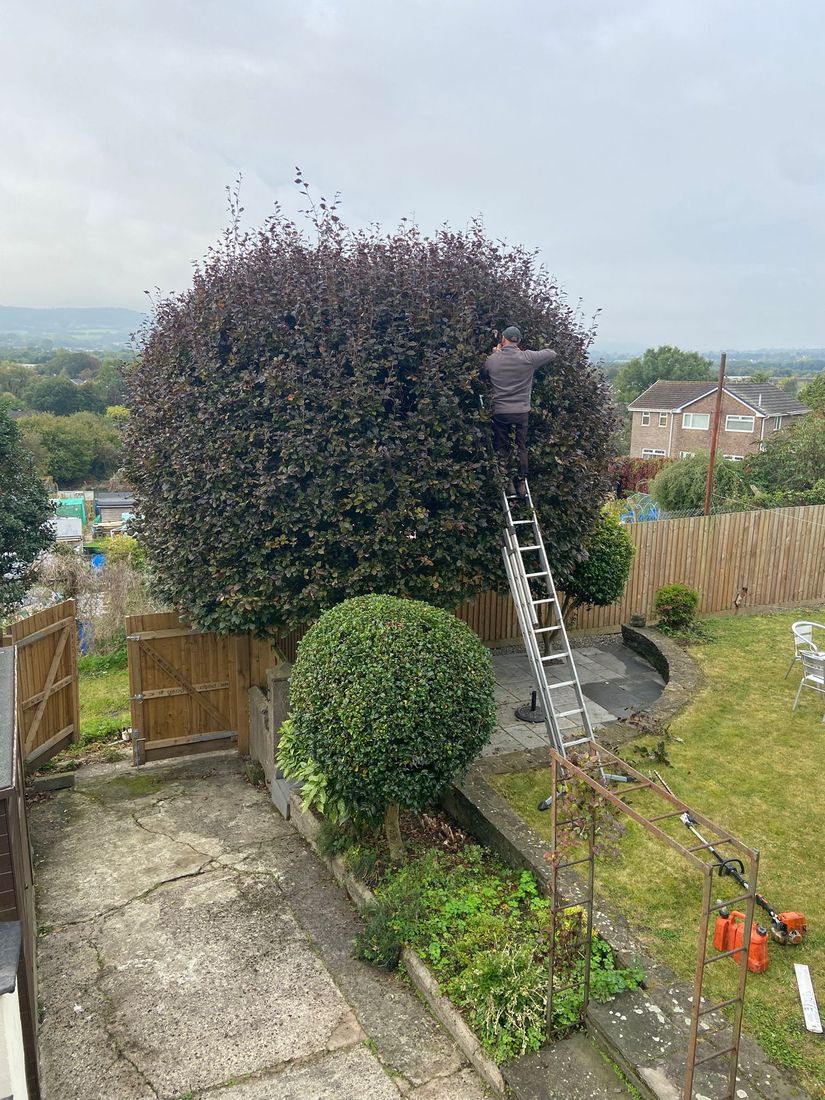
Where a conifer still has enough live growth, we reduce it gradually. We start with the sides and then lower the top, always leaving green foliage on every branch. Rather than flattening the top, we aim for a natural, tapered outline. Large reductions may be spread over more than one season so the tree is not shocked. Afterwards we remove all the cuttings and leave the area clear. We bring chippers and tidy up as we go.
Sometimes honesty means saying that cutting will not work. If a conifer is bare and brown inside, very tall, leaning or too close to a house, drain or wall, reduction may give an ugly result and need repeating. In that case, taking it down and replacing it with a more suitable hedge or planting can be the sensible choice. We will say plainly which route we think is right for your trees. Stump grinding can be arranged if you plan to replant.
Conifers are popular nesting places, and birds, nests, eggs and young are protected. We avoid heavy cutting in the spring and summer nesting season, and we check for nests before starting at any other time. Late summer to winter is usually the most suitable window for reductions. Dry, calm days make the work safer, so we plan around the weather, which in Wales can change quickly. Wind speed is as important as rain, because tall conifers sway badly in gusts.
Tall conifers mean working at height, often from ladders or with climbing gear, with heavy branches falling around the base. Hedge trimmers and chainsaws at height cause serious accidents. Trees close to power lines are more hazardous still. Please do not attempt to cut the top off a large conifer yourself, and do not lean ladders against branches that may not take the weight.
Check whether the trees are protected, because trees can be protected by a Tree Preservation Order or by being in a conservation area, and the local council is the place to ask. In Wales, felling larger amounts of timber may also need a felling licence from Natural Resources Wales. Neighbours may be affected, so a conversation helps. We give a free quotation after seeing the job. We can also advise on the most suitable replacement planting.
We will visit, tell you honestly what is needed and give you a free, no-obligation quotation.
No. Leylandii and most other conifers will not sprout again from bare wood, so cutting into the brown centre leaves permanent holes or kills the branch. Any reduction must keep live green growth on every branch, which limits how much can be taken off. It is a very common mistake.
That depends on how much green foliage remains. We only cut within the live growth, so a conifer that has been left to grow wild may only allow a modest reduction. Where more is needed, we may stage the work over two or more seasons.
Sometimes. If the tree is bare inside, leaning or too close to buildings, a reduction may look poor and need repeating. Removal and replanting can then be the cleaner answer. We will give you an honest opinion after looking at them. Sometimes a fresh start is kinder to the garden.
Yes. Conifer reductions create a great deal of green waste, so we cart it all away and leave the garden tidy. We will also tell you at the quotation stage what is included, so there are no surprises about the cleaning up afterwards.
There is no single perfect month for every tree, but winter suits many species, and this guide shows how timing, nesting birds and weather affect the choice.
Read the guide →Regular pruning keeps trees safe, balanced and healthy, brings light back into gardens and buildings, and usually avoids the larger and more disruptive jobs that neglect leads to.
Read the guide →
Tree surgery is priced job by job rather than from a fixed list, so this guide explains what moves the cost up or down and how to get a firm figure.
Read the guide →Tell us what needs doing and where. We will come back to you, or call 07766 919630 if it is urgent.