Tree surgery is priced job by job rather than from a fixed list, so this guide explains what moves the cost up or down and how to get a firm figure.
Ask three householders what they paid for tree work and you will hear three very different stories. That is because no two trees, gardens or jobs are alike. A small ornamental pruned in an open front garden is a different task from a tall oak leaning over a valley terrace with a lane behind it. For that reason we do not publish a price list for tree surgery, and we would be wary of anyone who quotes a figure over the phone without seeing the tree.
The price reflects the time, people, equipment and risk involved in a job. Most of it comes down to a handful of practical factors, and once you know them you can see why two similar looking trees can be priced quite differently. These are the points we weigh up whenever we assess a job, and they are worth thinking about before you ask for quotations.
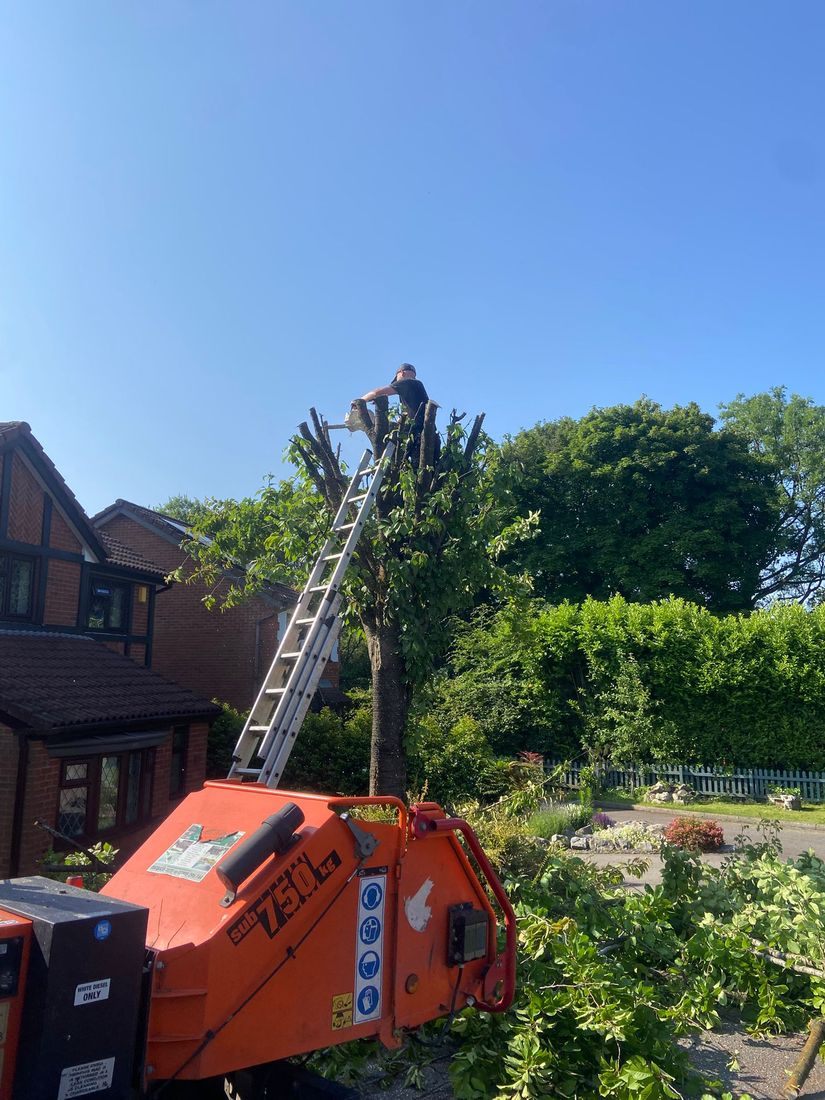
Many South Wales gardens are terraced, sloping or reached only through the house or a narrow back lane. When timber cannot be driven up to a chipper or lifted straight onto a lorry, it has to be carried or lowered by hand, and that takes longer. Soft, wet ground after our regular rain can also limit where machinery may go without damaging lawns. None of this is a problem, but it is the sort of thing that only shows up when someone walks the site.
Clearing up is part of the job, and how much there is to clear matters. A large tree produces a surprising volume of branches, logs and chippings, and disposing of it properly has a cost of its own. Some customers want the logs left for the fire, which can change what we take away. Stump removal is a separate decision: a stump can be cut low and left, or ground out by arrangement, and each option affects the final figure. It is worth deciding what you want before the visit, because it saves confusion later. Tell us whether you want the wood logged and left, the stump removed, or everything cleared away, and we will price it clearly.
Before any cutting starts, it is worth checking whether the tree is protected. Trees can be protected by a Tree Preservation Order or by standing in a conservation area, and your local council is the place to check. In Wales, felling larger amounts of timber may also need a felling licence from Natural Resources Wales, so check if that could apply. Timing matters too, because we avoid disturbing nesting birds in spring and summer. Neighbours matter as well. If a tree overhangs a boundary or stands close to a shared wall, it helps to let them know before work begins.
The dependable way to know what your tree work will cost is to have someone look at it. We visit, talk through what you want, and give a free quotation once we have seen the tree and the access. Ask any firm to write down exactly what is included, such as waste removal, stump treatment and clearing up, so you can compare like with like rather than just comparing totals.
We will visit, tell you honestly what is needed and give you a free, no-obligation quotation.
Tree work depends on things a phone call cannot show: the height and condition of the tree, how we reach it, what is nearby and how much waste there will be. Seeing the job lets us give you an honest figure that will not change halfway through.
We state clearly in the quotation what is covered, including whether timber and green waste are removed and whether the stump is left or ground out. If you would like to keep the logs, tell us at the visit and we will write it into the quotation.
Not always. A small tree in a tight garden with no side access can take more effort than a larger one in the open. Size matters, but access, hazards and waste often matter just as much, which is why every job is looked at individually.
Possibly. Check with your local council whether the tree has a Tree Preservation Order or stands in a conservation area. Larger felling in Wales may also need a felling licence from Natural Resources Wales. We can talk you through what to check at the visit, and we will not start work until you are sure.
Most trees are perfectly safe, but certain signs suggest a tree is weakened, and knowing what to look for helps you act before something falls.
Read the guide →Stay calm, keep clear of the tree and any cables, and call for help, because a fallen tree can still be unstable and dangerous long after the wind drops.
Read the guide →A few sensible checks in early autumn can reduce the damage that gales and heavy rain do to trees, fences, hedges and outbuildings across South Wales.
Read the guide →Tell us what needs doing and where. We will come back to you, or call 07766 919630 if it is urgent.