Some tree problems can wait for the next tidy-up, but others should not, and knowing the difference helps you act early and avoid damage to your home.
Healthy trees can live for generations, but they do not usually fail without hint. Many show changes in the weeks, months or years before a branch drops or a trunk gives way. You do not need to be an expert to notice them. If you look at your trees a couple of times a year, from the ground, you will soon learn what normal looks like and spot what has changed. The sooner a professional sees a problem, the more options there are.
Some signs point to a tree that could drop wood or fall. Do not stand beneath it while you decide what to do, and keep children and pets away from the area. Call us promptly if you notice any of the following, especially near the house, a shed, a path, a road or a neighbour's property.
Not every concern is urgent. Branches rubbing a roof, shading a window or sweeping across a lawn are a nuisance rather than an immediate danger, though they can cause damage over time. Roots lifting a path or a drive, gutters blocked with leaves, or a tree that has simply outgrown its space can usually be planned for. Booking in the quieter months often gives you a wider choice of dates, and winter is a good time for many species.
Sometimes you just want to know whether a tree is a problem. A visit can answer questions that are hard to settle from the garden. Is the tree sound inside? Would a reduction help, or is removal the safer choice? What is growing nearby that might be affected? We will explain the options plainly, including leaving the tree alone if that is right, and you decide what suits your garden and your budget.
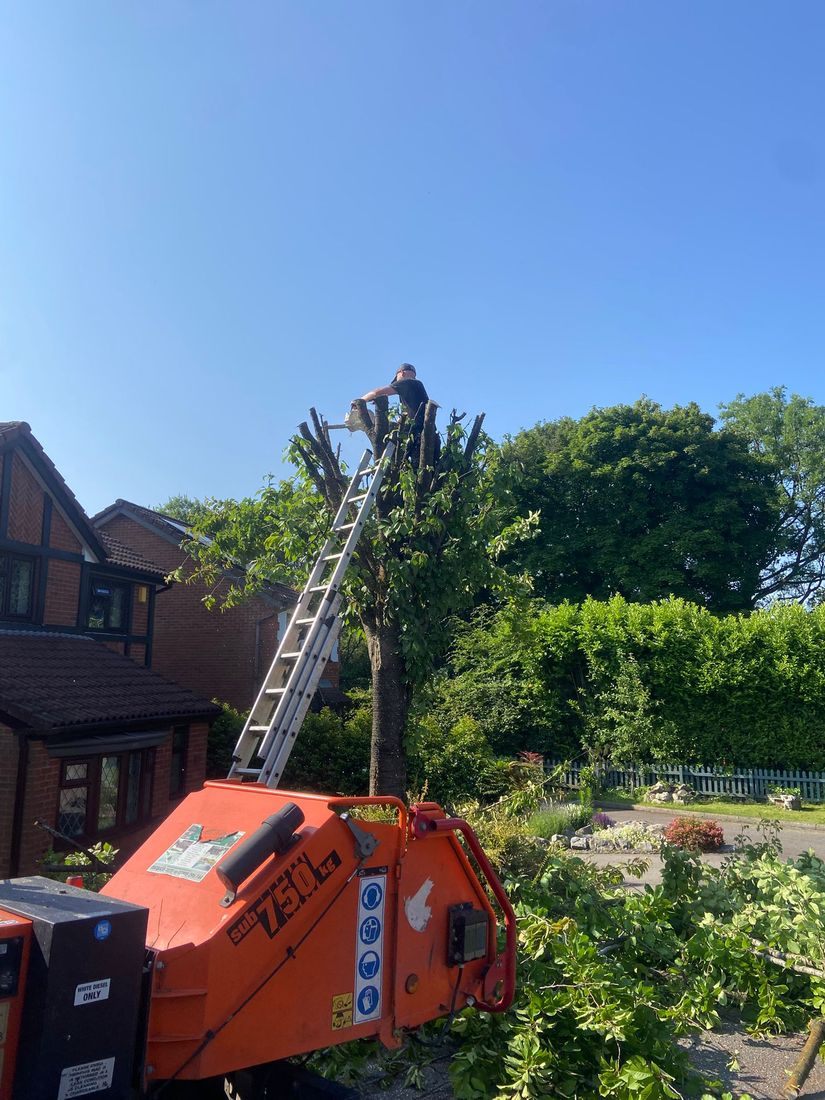
Ground-level tasks are fine: watching, photographing a changing tree, clearing fallen leaves and small twigs, and keeping the area beneath clear. Do not climb, use a chainsaw above shoulder height, or cut anything near cables. Even small trees can drop heavy branches in unexpected directions, and a fall from a ladder is a far worse outcome than a tree left for a professional.
A tree may be protected by a Tree Preservation Order, or by standing in a conservation area, and cutting it without permission can lead to enforcement action. Your local council can tell you, and it is worth asking before you book. In Wales, felling larger amounts of timber may also need a felling licence from Natural Resources Wales, so check before planning bigger work. We can talk through what applies to your site.
The right moment to call is as soon as something looks wrong, not after it has failed. Tell us where the tree is, roughly how tall it is, what is nearby and what you have noticed. Photographs help. We will visit, look at the tree and the access, and give you a free quotation after seeing the job, with a clear explanation of what we recommend and why.
We will visit, tell you honestly what is needed and give you a free, no-obligation quotation.
A quick look from the ground once or twice a year is enough for most gardens, ideally in autumn and again in spring. Large mature trees near buildings, roads or play areas deserve a closer check from a tree surgeon every few years, and after severe weather.
Not always, but fungus at the base or on the trunk can mean decay inside or in the roots. Because that is hard to judge from a distance, it is worth having a tree surgeon look at it, particularly if the tree is large or close to a building.
Yes. Many calls start as a simple question about whether a tree is safe. We would rather you ask early than wait. If the right answer is to leave a tree alone, we will say so, and explain what to keep an eye on.
You need permission from the local council before cutting, other than in a few exceptions such as an immediate danger. Applications take time, so ask early. We can help describe the work needed, and the council will tell you what it needs to see.
Tree surgery is priced job by job rather than from a fixed list, so this guide explains what moves the cost up or down and how to get a firm figure.
Read the guide →Most trees are perfectly safe, but certain signs suggest a tree is weakened, and knowing what to look for helps you act before something falls.
Read the guide →Stay calm, keep clear of the tree and any cables, and call for help, because a fallen tree can still be unstable and dangerous long after the wind drops.
Read the guide →Tell us what needs doing and where. We will come back to you, or call 07766 919630 if it is urgent.